
Who Can Stand Under the Chuppah With Us During Our Jewish Wedding?

When couples begin their Jewish Wedding Planning, they usually think first about the big decisions.
The Jewish Wedding Venue.
The guest list.
The Jewish Wedding Photographer.
The food.
The Jewish Wedding Music.
Then, as we begin talking about the actual Jewish Wedding Ceremony, a very specific question often comes up:
“Who can stand under the chuppah with us?”
My answer is that there can be flexibility, and I love helping couples decide what will feel most meaningful for them.
For some couples, that means parents standing beneath the Jewish Wedding Chuppah. For others, grandparents or other loved ones may have an important role. Some couples prefer a more intimate chuppah with just themselves and me officiating.
The important thing is understanding the tradition and then creating a ceremony that feels authentically yours.
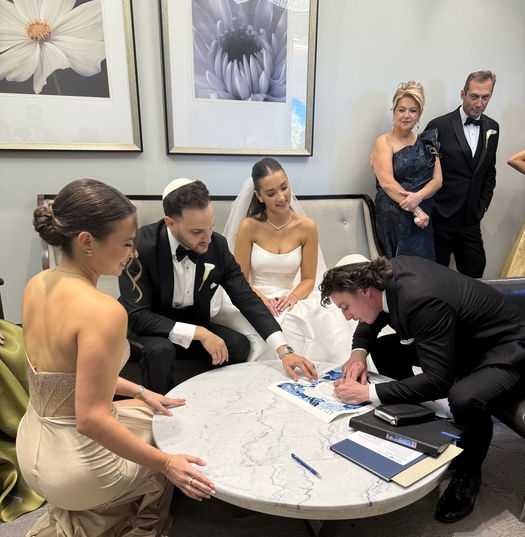
I saw this beautifully when I had the privilege of getting to know and marrying Ashley and Brad, a wonderful Jewish couple from Toronto.
What Does The Jewish Wedding Chuppah Actually Represent?
Before deciding who should stand beneath it, it helps to understand what the chuppah means.
The chuppah is one of the most recognizable Jewish Wedding Traditions.
Its symbolism is beautiful.
The Jewish Wedding Chuppah represents the home the couple is beginning to create together. Traditionally, it is open on all sides, often understood as representing hospitality and a home that welcomes others.
But notice something important.
There are no walls.
To me, that is an extraordinary image for marriage.
You are building a home together, but you are not building walls around yourselves.
You remain connected to family, friends, community and the generations that came before you.
That is why the question of who stands beneath the chuppah can become surprisingly emotional.
Ashley And Brad Had People Who Mattered Deeply To Them
When I work with a couple like Ashley and Brad, I do not want to treat their ceremony like a template.
I want to know them.
I ask questions about their relationship.
How did they meet?
What attracted them to each other?
What makes them laugh?
What do they admire about one another?
What have they learned from each other?
Who shaped the people they became?
Those conversations allow me to understand not only the couple, but also the family relationships surrounding them.
That matters when we discuss who will participate in the ceremony.
A wedding should not feel like names have simply been inserted into a script.
It should feel like somebody took the time to understand why these two particular people are standing beneath this particular chuppah.
Do Our Parents Have To Stand Under The Chuppah?
Parents commonly stand beneath the chuppah during Jewish Wedding Celebrations, and it can be incredibly meaningful.
But couples sometimes worry that there is only one acceptable arrangement.
Families are complicated.
A parent may have passed away.
Parents may be divorced.
Someone may have remarried.
A couple may be extraordinarily close with a stepparent.
A grandparent may have played a parental role.
There may be difficult family relationships that make a traditional arrangement uncomfortable.
This is where thoughtful Jewish Wedding Planning becomes important.
I talk these situations through with my couples.
Rather than automatically saying, “This is how everybody does it,” I want to understand the family standing in front of me.
What About Grandparents?
Grandparents can have a beautiful place within a Jewish Wedding Ceremony.
Sometimes couples want grandparents to participate because they represent continuity.
Think about the image.
A grandparent watches a grandchild stand beneath a Jewish Wedding Chuppah and begin a marriage.
One generation is witnessing the next generation continue the Jewish story.
That can be incredibly moving.
Grandparents can also be honoured in other meaningful ways if standing for the entire ceremony would be physically difficult.
Honouring somebody does not require making them uncomfortable.
The goal is to create a meaningful moment, not to satisfy an imaginary wedding rulebook.
Who Else Can Participate?
Depending upon the ceremony you create, there may be meaningful roles for siblings, close family members and friends.
Some people may participate in blessings.
Others may be involved with the Jewish Wedding Ketubah.
Someone meaningful may be invited for a special honour.
The exact structure should be discussed in advance with your Jewish Wedding Officiant so everyone understands what is happening.
This is one of the reasons I spend time getting to know my couples before their wedding.
I want to know who matters to you and why.
Traditional Does Not Have To Mean Impersonal
Couples sometimes assume they must choose between Traditional Jewish Weddings and Modern Jewish Weddings.
I do not see it that way.
You can honour Jewish Wedding Rituals, Jewish Wedding Customs and Jewish Wedding Traditions while still creating something deeply personal.
Tradition gives us the foundation.
Personalization gives the ceremony its heart.
I was mentored by a great Jewish wedding Rabbi.
Over the years, I have developed an approach that combines my experience as a Jewish Wedding Cantor, licensed Ontario wedding officiant, singer, storyteller and certified Life Coach.
That combination allows me to look at your ceremony from several perspectives.
I care about the Jewish tradition.
I care about the legal marriage.
I care about the music.
But I also care enormously about how the ceremony makes you and your guests feel.
Your Chuppah Should Tell A Story
Imagine your Jewish Wedding Photographer capturing one photograph beneath the chuppah.
Who do you want in that photograph?
That is an interesting question.
Because decades later, the Jewish Wedding Decorations may be gone.
The Jewish Wedding Invitations will probably be sitting in a box.
You may barely remember what appetizers were served at the Jewish Wedding Reception.
But that photograph may still be hanging on your wall.
That is why I encourage couples to think beyond wedding logistics.
Who are the people whose presence represents your story?
For Ashley and Brad, that conversation was not simply about where everybody should stand.
It was about family.
It was about relationships.
It was about creating a ceremony that reflected who they were.
What About The Other Jewish Wedding Traditions?
The chuppah is only one part of the ceremony.
Depending upon the ceremony a couple chooses, we may incorporate the Jewish Wedding Ketubah, wine, rings, blessings, Jewish Wedding Vows, beautiful Jewish Wedding Music and the breaking of the glass.
Then comes the Mazel Tov.
And after that, perhaps a Jewish Wedding Hora and Jewish Wedding Dance as the Jewish Wedding Celebrations really begin.
I explain the traditions because I do not believe guests should simply watch Jewish Wedding Rituals without understanding their meaning.
A ceremony becomes far more powerful when people understand why something is happening.
Why Choosing The Right Officiant Matters
If you are searching for Jewish Wedding Services or planning a Jewish Wedding Toronto celebration, do not choose your officiant based only on whether someone is available on your date.
Ask yourself what you want your ceremony to feel like.
Do you want someone who gets to know you?
Do you want your love story included?
Do you want Jewish traditions explained in language everyone can understand?
Do you want beautiful cantorial singing?
Do you want guidance when family relationships make certain decisions complicated?
This is where I deliberately offer something different.
I do not believe my job begins when I walk beneath your chuppah.
My job begins much earlier, when I start getting to know the two people who will eventually stand beneath it.
That is the difference I want couples to experience.
Your Jewish Story May Continue
One of the beautiful things about officiating weddings is that sometimes I am invited into another chapter of a family’s Jewish life later.
A couple may eventually contact me about a Baby naming ceremony or specifically a Baby naming ceremony Jewish families can personalize.
I also provide Jewish Baby Naming Services and can help families think through Jewish Baby Naming Rituals, a Jewish Newborn Ceremony and other Jewish newborn ceremonies.
That may include serving as a Jewish Baby Naming Officiant and helping with Jewish Baby Naming Tradition, Jewish Baby Naming Celebration, Jewish Baby Naming Ceremony Planning, a Jewish Baby Naming Invitation, Jewish Baby Naming Ceremony Music and a Jewish Baby Naming Reception.
The lifecycle changes.
The central idea remains the same.
Jewish tradition becomes most powerful when it connects to the real people experiencing it.
So Who Should Stand Under Your Chuppah?
The people who belong there as part of the meaningful ceremony you are creating.
For many couples, parents will have an important place.
For others, grandparents, stepparents or other loved ones may need consideration.
And some couples may want the physical space beneath the chuppah to remain especially intimate.
Do not make that decision simply because you saw somebody else’s wedding photographs.
Talk about it.
Think about the relationships involved.
Then create a ceremony that honours Jewish tradition while still feeling unmistakably like you.
If you are planning a Jewish Wedding Toronto celebration and wondering how to structure your chuppah, I would love to hear about you, your families and the people you hope to honour.
Because when Ashley and Brad stood beneath their chuppah, I did not want them participating in somebody else’s Jewish wedding.
I wanted them to experience Ashley and Brad’s Jewish wedding.
That distinction is everything.


Comments