
What If One of Our Parents Is Not in Great Health on Our Wedding Day?

One of the most emotional concerns a couple can bring into Jewish Wedding Planning has nothing to do with flowers, food, music, or photography.
It sounds more like this:
“Cantor Ben, one of our parents is not in great health. We desperately want them at the wedding, but we are worried the ceremony may be too much for them. What do we do?”
My answer is that we plan thoughtfully, and then we remain flexible.
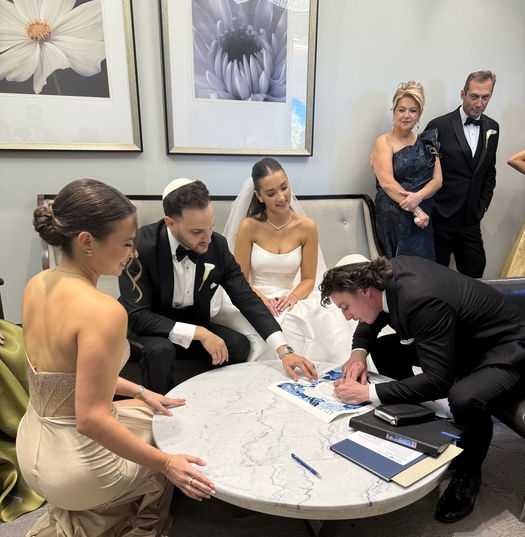
That was important when I worked with Sheri and Adam, a wonderful Jewish couple from Toronto whose Jewish Wedding Ceremony I had the privilege of officiating.
When somebody important to the bride or groom is dealing with health limitations, I never want the family thinking that they have only two choices:
Either the parent participates exactly as everyone else does, or they cannot participate meaningfully at all.
There is often a much better option.
We adapt the ceremony around the person rather than forcing the person to adapt to the ceremony.
A Parent Does Not Have To Stand Throughout The Ceremony
This is one of the simplest accommodations, yet it can make an enormous difference.
If a parent or grandparent cannot comfortably stand for the entire Jewish Wedding Ceremony, we can arrange seating beneath or very close to the Jewish Wedding Chuppah.
They can still be part of the moment.
They can still be close to the couple.
They can still hear everything.
They can still appear in those extraordinary photographs.
And they can participate without spending the ceremony worried about whether they can physically make it to the end.
Being seated does not make someone less important to the ceremony.
Sometimes the most loving decision is simply to make participation easier.
I Can Shorten The Ceremony On The Spot
There is another layer of flexibility that couples find reassuring.
Sometimes everyone feels wonderful when the ceremony begins.
Then partway through, somebody does not.
Maybe a parent looks uncomfortable.
Maybe the heat is affecting them.
Maybe standing or sitting for longer than expected is becoming difficult.
If I receive the appropriate signal or the bride and groom tell me that we need to move more quickly, I can adjust.
I know how to preserve the essential parts of the ceremony, including what is required for me to solemnize the marriage legally, while shortening other portions dramatically.
That does not mean suddenly rushing through the wedding.
It means knowing what matters most.
A good Jewish Wedding Officiant should not be so attached to a script that the script becomes more important than the people standing in front of them.
I Take My Cue From The Bride And Groom
This is very important to me.
I do not want to look at somebody’s parent and independently decide that they appear tired, therefore I am changing the wedding.
The bride and groom know their family.
They understand what is normal.
They may have already discussed the situation privately with their parent.
So before the wedding, we can create a simple understanding.
If Sheri or Adam gives me a particular signal, or somebody quietly communicates with me on their behalf, I know we need to shorten things.
That allows the couple to remain in control of their Jewish Wedding Ceremony.
Flexibility works best when it is planned before it is needed.
Meaning Does Not Depend On Length
Couples sometimes worry:
“If we shorten the ceremony, will it still feel meaningful?”
Absolutely.
Meaning does not come from how many minutes everyone stands beneath the chuppah.
It comes from what happens during those minutes.
The Jewish Wedding Ketubah.
The wine.
The rings.
The blessings.
The Jewish Wedding Chuppah.
The couple’s commitment.
The breaking of the glass.
These Jewish Wedding Rituals and Jewish Wedding Traditions can remain deeply powerful even when I need to adjust the pacing.
I have always believed that a ceremony should be emotionally engaging rather than unnecessarily long.
If circumstances require me to make it even more concise, I can do that.
Shorter does not have to mean less meaningful.
This Is Why Experience Matters
I was mentored by a great Jewish wedding Rabbi.
My own approach combines my work as a Jewish Wedding Cantor, licensed Ontario wedding officiant, singer, storyteller, public speaker, and certified Life Coach.
That combination matters in moments like this.
As a licensed officiant, I understand the legal responsibilities of the marriage.
As a Cantor, I understand Jewish Wedding Customs and Traditional Jewish Weddings.
As a storyteller and speaker, I can adjust my delivery without making the ceremony suddenly feel awkward.
As a Life Coach, I pay attention to the emotional experience of the people involved.
I am not thinking only about what comes next in a script.
I am thinking:
“What does this family need from me right now?”
That is a different way of approaching Jewish Wedding Services.
Personalization Is More Than Telling The Couple’s Story
When people hear Personalized Jewish Wedding, they often think about the speech.
And yes, I take time to learn about Sheri and Adam.
What they love about each other.
What they admire.
What they enjoy doing together.
Why they are choosing marriage.
I weave their relationship into the ceremony using Jewish wisdom, psychology, inspiration, and life coaching.
But personalization also means adapting the physical experience.
Modern Jewish Weddings should not force every family into identical circumstances.
If someone needs a chair, we use a chair.
If somebody needs the ceremony shortened, we can shorten it.
If a parent needs to participate differently, we find a meaningful way.
Personalization is not decoration. It is designing the experience around the actual people who are living it.
Tell Me About Health Concerns Before The Wedding
If one of your parents or grandparents has health challenges, please tell me.
You do not need to give me private medical details that are irrelevant.
What I need to know is practical.
Can they stand comfortably?
Would sitting beneath the chuppah help?
Do they tire easily?
Would it be useful for us to agree upon a signal that tells me to shorten the ceremony?
Who should communicate with me if something changes?
Those conversations make Jewish Wedding Planning much easier.
They also reduce anxiety because the couple knows there is already a plan.
Your Parent’s Presence May Matter More Than Perfect Logistics
Couples spend months thinking about their Jewish Wedding Venue, Jewish Wedding Photographer, Jewish Wedding Decorations, Jewish Wedding Invitations, Jewish Wedding Attire, Jewish Wedding Music, Jewish Wedding Reception, Jewish Wedding Dance, and Jewish Wedding Hora.
All of those things can contribute to beautiful Jewish Wedding Celebrations.
But if a parent is in fragile health, the couple may eventually realize something.
They will not remember whether every logistical detail went perfectly.
They will remember that Mom was there.
That Dad saw them beneath the chuppah.
That a grandparent heard the blessings.
That somebody they deeply loved was able to witness the beginning of their marriage.
People are more important than plans.
Sometimes The Family Story Continues
One of the privileges of officiating weddings is sometimes being invited back into a family’s life later.
A couple may eventually contact me about a Baby naming ceremony or ask how a Baby naming ceremony Jewish tradition can feel warm and personal.
I also provide Jewish Baby Naming Services, Jewish Baby Naming Rituals, a Jewish Newborn Ceremony, other Jewish newborn ceremonies, and serve as a Jewish Baby Naming Officiant.
Families may want guidance with Jewish Baby Naming Tradition, Jewish Baby Naming Celebration, Jewish Baby Naming Ceremony Planning, a Jewish Baby Naming Invitation, Jewish Baby Naming Ceremony Music, or a Jewish Baby Naming Reception.
Those moments remind me that a wedding is not an isolated event.
It is the beginning of a family story.
What If One Of Your Parents Is Not In Great Health?
Do not assume they have to stand throughout your wedding.
Do not assume the ceremony cannot be adapted.
And do not assume that changing the plan somehow makes the wedding less beautiful.
If you are planning a Jewish Wedding Toronto celebration and a parent or grandparent is dealing with health limitations, reach out to me early.
Tell me what concerns you.
Tell me what would make them comfortable.
Tell me how involved you want them to be.
Then we can build flexibility into the plan before your wedding day ever arrives.
And if circumstances change while I am standing beneath the chuppah with you, I can adapt.
Because Sheri and Adam’s ceremony was never supposed to be about protecting my script.
It was about protecting the meaning of their moment.
The ceremony should serve the family. The family should never have to serve the ceremony.


Comments